Save more
Question: which config and which keep-alive strategy would have cost me least, on my own history?
/context-guru:save-more replays your past sessions on the proxy under every config Context Guru ships (each preset) and every keep-alive strategy, and shows what each would have saved. It recommends the best of each, asks you once, and changes nothing without a yes.
| Command | What it does |
|---|---|
/context-guru:save-more |
both reports, a combined summary, one question at the end |
/context-guru:save-more config |
every shipped preset; --custom also searches single components, their combinations and their order |
/context-guru:save-more cache |
every keep-alive strategy, with the savings by day of week and hour |
/context-guru:save-more settings |
only the "Settings that cost you money" card |
/context-guru:save-more apply <config\|cache> <option>@<basis> |
make a change the screen offered (after a yes) |
/context-guru:save-more revert <config\|cache> |
undo the last change made here |
Add details for every option and the held-out comparison, and --days N for the window (default 30 days). The replay can take a few minutes; on a terminal a seconds counter runs meanwhile.
Codex: $context-guru-save-more, with the same words.
The screen
Each report opens with a card that answers two questions in plain words: what your current setting saved so far, and what the recommended change would have saved per week over the same past sessions, with its range. Then a ranked table of every option, and the caveats.
╭─ Save more: config ─────────────────────────────────────────────────────────────────────────────╮
│ So far: your current config saved $9.40 in 30 days (observed).                                  │
│ Change: preset conservative -> medium. Over the last 30 days it would have saved about $1.49 a  │
│ week (range $0.40 to $2.70).                                                                    │
╰─────────────────────────────────────────────────────────────────────────────────────────────────╯
medium would have saved $6.40 more than your current conservative preset on the requests that could
be replayed.

     option                                       saved  spent      net
  ★  medium        + cheap-model relevance pass  $17.90  $2.10  ≈$15.80  ████████████
     high          + summary near a full window  $18.40  $3.50  ≈$14.90  ███████████░
  ▸  current       Your config (conservative)     $9.60  $0.20    $9.40  ███████░░░░░
  ◦  conservative  Trim obvious waste             $9.60  $0.20    $9.40  ███████░░░░░
     off           No compaction                     $0     $0       $0  ░░░░░░░░░░░░
  ★ recommended   ▸ yours now   ◦ the default   ≈ partly estimated
  1 more not evaluated: too few cold turns in the window to replay
  saved: what it avoided paying · spent: what it paid itself · net = saved - spent, on your past
  sessions

  counterfactual · every shipped preset replayed on your stored requests · 2026-09-08..2026-10-08 ·
  40 sessions, 3,100 requests
  ! The replay covers 14% of requests; on the rest the presets were not compared.
  ! medium and high include model components whose output is estimated, not re-run.

Recommended: preset conservative -> medium (takes effect now).
Why: highest net on your own sessions, after its own model spend
Apply it? Say yes, or run: /context-guru:save-more apply config medium@a1b2c3d4

╭─ Save more: cache ──────────────────────────────────────────────────────────────────────────────╮
│ So far: your current keep-alive strategy saved $31.10 in 30 days (observed).                    │
│ Change: cache strategy 5-min-ping -> adaptive. Over the last 30 days it would have saved about  │
│ $2.89 a week (95% CI $0.72 to $4.89).                                                           │
│ Before -> after: $300.00 billed on these sessions, $287.00 with the change.                     │
╰─────────────────────────────────────────────────────────────────────────────────────────────────╯
switch to adaptive keep-alive to save about $12.40 more over the last 30 days.
  best vs default +$12.40 (95% CI $3.10 to $21.00)  ·  best vs current +$12.40 (95% CI $3.10 to
  $21.00)

      option                            saved  spent     net
  ★   adaptive    Adaptive keep-alive  $51.20  $7.70  $43.50  ████████████
  ▸◦  5-min-ping  Ping every 5 min     $40.10  $9.00  $31.10  █████████░░░
      none        No pings                 $0     $0      $0  ░░░░░░░░░░░░
  ★ recommended   ▸ yours now   ◦ the default
  1 more not evaluated: too little history: 13 held-out sessions (need 20)
  saved: what it avoided paying · spent: what it paid itself · net = saved - spent, on your past
  sessions

  What adaptive keep-alive adds over the default, by hour (Europe/Amsterdam)
        0     6     12    18   23
  Mon   ░░░ ░░ ░░▒░░▒█░░▓█▓░░ ░░
  Tue   ░░░░░░░░▓░░░▓▒▒▓▒▒█░░░░░
  Wed   ░░░░░░░░░▓█▓█▒▓▓▓▒█░░░ ░
  Thu   ░░░░░░ ░░░░█░▒▒█░▒▓░░░░░
  Fri   ░░░░░░░░▓▒ ▒▒▓█▓▓▓▓ ░░░░
  Sat   ░░░░  ░░░  ░░░ ░░░░░░░░░
  Sun   ░░░░░░░░ ░░░░ ░░░░░░░░░░
        ░ little   █ most (up to $0.38 in one hour slot)

  counterfactual · replay of past sessions · 2026-09-08..2026-10-08 · 412 sessions, 18,301 requests
  ! 31 sessions ended inside the window; their last gap is censored.

Recommended: cache strategy 5-min-ping -> adaptive (takes effect at the next proxy restart).
Why: it had the highest net on your own sessions
Apply it? Say yes, or run: /context-guru:save-more apply cache adaptive@3f9a1c

╭─ Save more: both ──────────────────────────────────────────────────────────────────────────╮
│ config  saved so far    $9.40   the recommended change would have saved about $1.49 a week │
│ cache   saved so far   $31.10   the recommended change would have saved about $2.89 a week │
╰────────────────────────────────────────────────────────────────────────────────────────────╯
Question: apply both, only one of them, or neither?
★is the recommended option,▸the one you have now,◦the default. When the option with the highest net is not recommended (it failed the proxy's own check, or the gain is too small to trust) it is marked☆.- saved is what the option avoided paying, spent what it paid for itself (pings, Context Guru's own model calls), net is saved minus spent.
≈marks a figure that is partly estimated rather than replayed (a model component whose output could not be re-run). - For cache, the grid shows where in the week the recommended strategy adds its savings: darker cells saved more. Hours are UTC.
- The footer says how the numbers were obtained (
observedorcounterfactual), the window, and how many sessions and requests it covers. Lines starting with!are caveats about the data.
It reads the same at 80 columns and without Unicode or colour (CG_ASCII=1, NO_COLOR=1):
+- Save more: config ---------------------------------------------------------+
| So far: your current config saved $9.40 in 30 days (observed).              |
| Change: preset conservative -> medium. Over the last 30 days it would have  |
| saved about $1.49 a week (range $0.40 to $2.70).                            |
+-----------------------------------------------------------------------------+
medium would have saved $6.40 more than your current conservative preset on the
requests that could be replayed.

     option                                 saved  spent      net
  *  medium        + cheap-model relevan~  $17.90  $2.10  ~$15.80  ############
     high          + summary near a full~  $18.40  $3.50  ~$14.90  ###########-
  >  current       Your config (conserva~   $9.60  $0.20    $9.40  #######-----
  d  conservative  Trim obvious waste       $9.60  $0.20    $9.40  #######-----
     off           No compaction               $0     $0       $0  ------------
  * recommended   > yours now   d the default   ~ partly estimated
  1 more not evaluated: too few cold turns in the window to replay
  saved: what it avoided paying | spent: what it paid itself | net = saved -
  spent, on your past sessions

  counterfactual | every shipped preset replayed on your stored requests |
  2026-09-08..2026-10-08 | 40 sessions, 3,100 requests
  ! The replay covers 14% of requests; on the rest the presets were not
  compared.
  ! medium and high include model components whose output is estimated, not re-
  run.

Recommended: preset conservative -> medium (takes effect now).
Why: highest net on your own sessions, after its own model spend
Apply it? Say yes, or run: /context-guru:save-more apply config medium@a1b2c3d4

+- Save more: cache ----------------------------------------------------------+
| So far: your current keep-alive strategy saved $31.10 in 30 days            |
| (observed).                                                                 |
| Change: cache strategy 5-min-ping -> adaptive. Over the last 30 days it     |
| would have saved about $2.89 a week (95% CI $0.72 to $4.89).                |
| Before -> after: $300.00 billed on these sessions, $287.00 with the change. |
+-----------------------------------------------------------------------------+
switch to adaptive keep-alive to save about $12.40 more over the last 30 days.
  best vs default +$12.40 (95% CI $3.10 to $21.00)  |  best vs current +$12.40
  (95% CI $3.10 to $21.00)

      option                            saved  spent     net
  *   adaptive    Adaptive keep-alive  $51.20  $7.70  $43.50  ############
  >d  5-min-ping  Ping every 5 min     $40.10  $9.00  $31.10  #########---
      none        No pings                 $0     $0      $0  ------------
  * recommended   > yours now   d the default
  1 more not evaluated: too little history: 13 held-out sessions (need 20)
  saved: what it avoided paying | spent: what it paid itself | net = saved -
  spent, on your past sessions

  What adaptive keep-alive adds over the default, by hour (Europe/Amsterdam)
        0     6     12    18   23
  Mon   ... .. ..:..:#..*#*.. ..
  Tue   ........*...*::*::#.....
  Wed   .........*#*#:***:#... .
  Thu   ...... ....#.::#.:*.....
  Fri   ........*: ::*#**** ....
  Sat   ....  ...  ... .........
  Sun   ........ .... ..........
        . little   # most (up to $0.38 in one hour slot)

  counterfactual | replay of past sessions | 2026-09-08..2026-10-08 | 412
  sessions, 18,301 requests
  ! 31 sessions ended inside the window; their last gap is censored.

Recommended: cache strategy 5-min-ping -> adaptive (takes effect at the next
proxy restart).
Why: it had the highest net on your own sessions
Apply it? Say yes, or run: /context-guru:save-more apply cache adaptive@3f9a1c

+- Save more: both -----------------------------------------------------------+
| config  saved so far    $9.40   the recommended change would have saved     |
| about $1.49 a week                                                          |
| cache   saved so far   $31.10   the recommended change would have saved     |
| about $2.89 a week                                                          |
+-----------------------------------------------------------------------------+
Question: apply both, only one of them, or neither?
Applying, and undoing
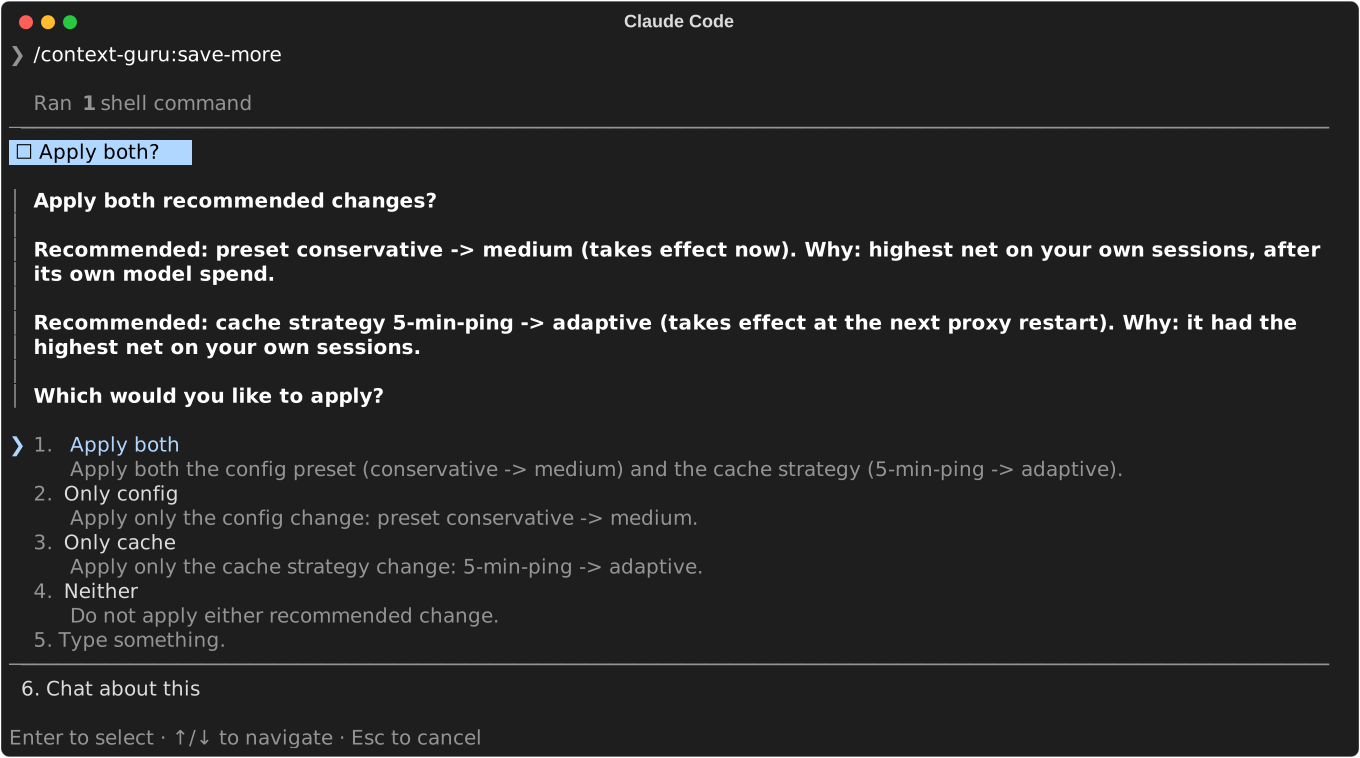
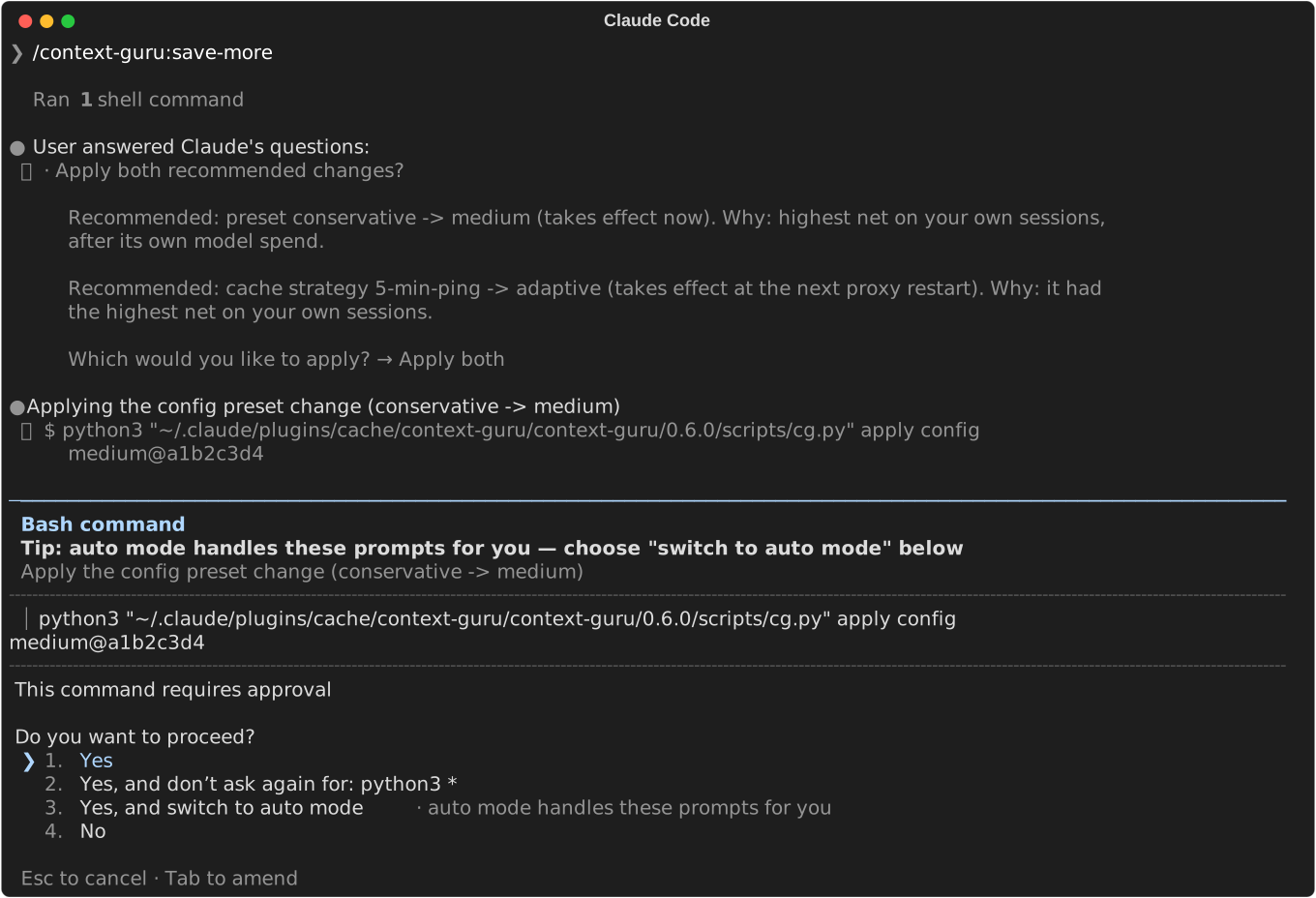
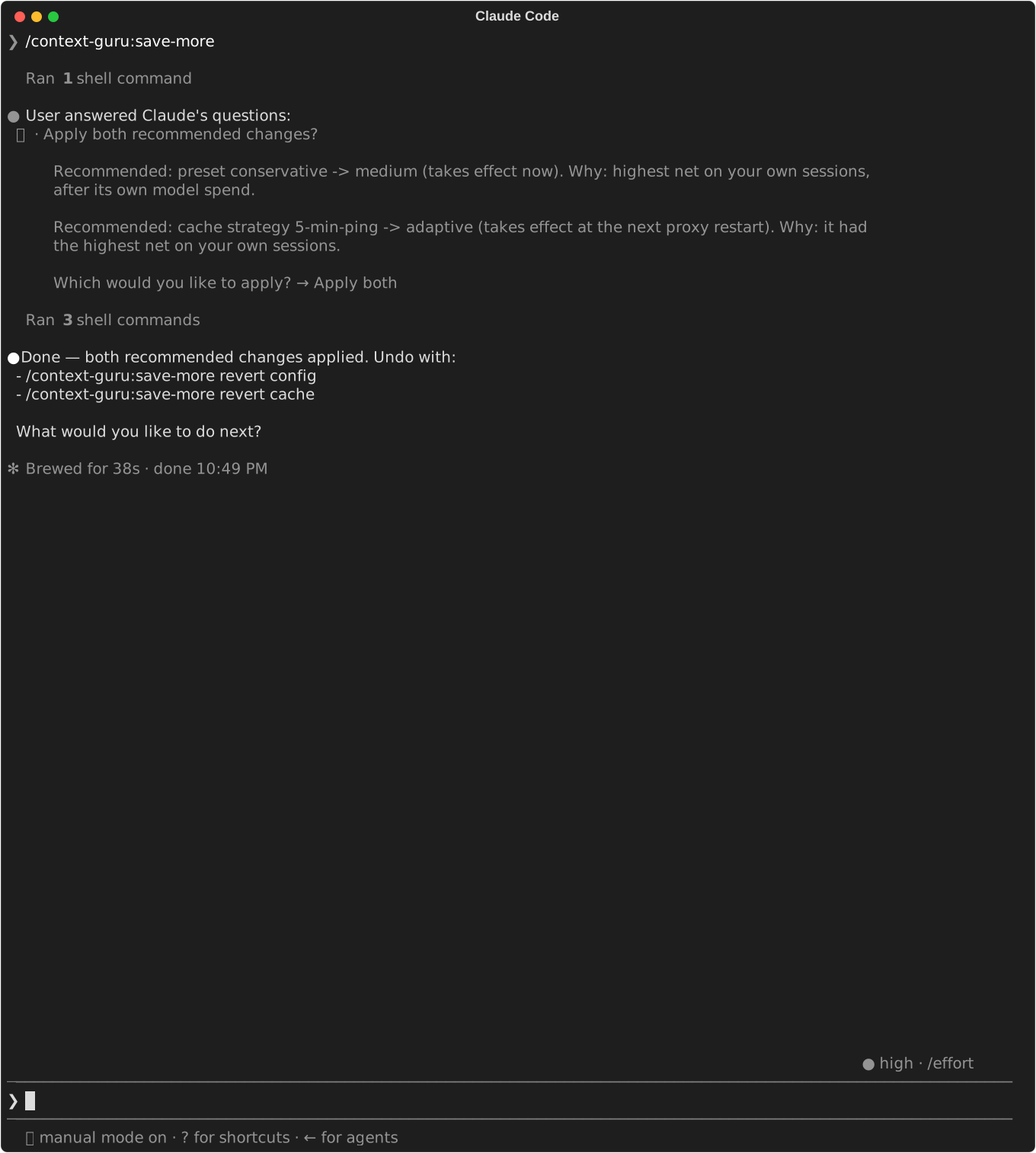
Looking never changes anything. When there is a recommendation, the report ends with an Apply it? line, and the command asks one question: "Apply both recommended changes?" with the choices both, only config, only cache, or neither. In Claude Code, the change itself is a separate command (cg.py apply or cg.py revert), so Claude Code also asks permission to run it; reads are pre-approved, changes never are. Run in a terminal, the command asks [y/N] for each change; the default is No.
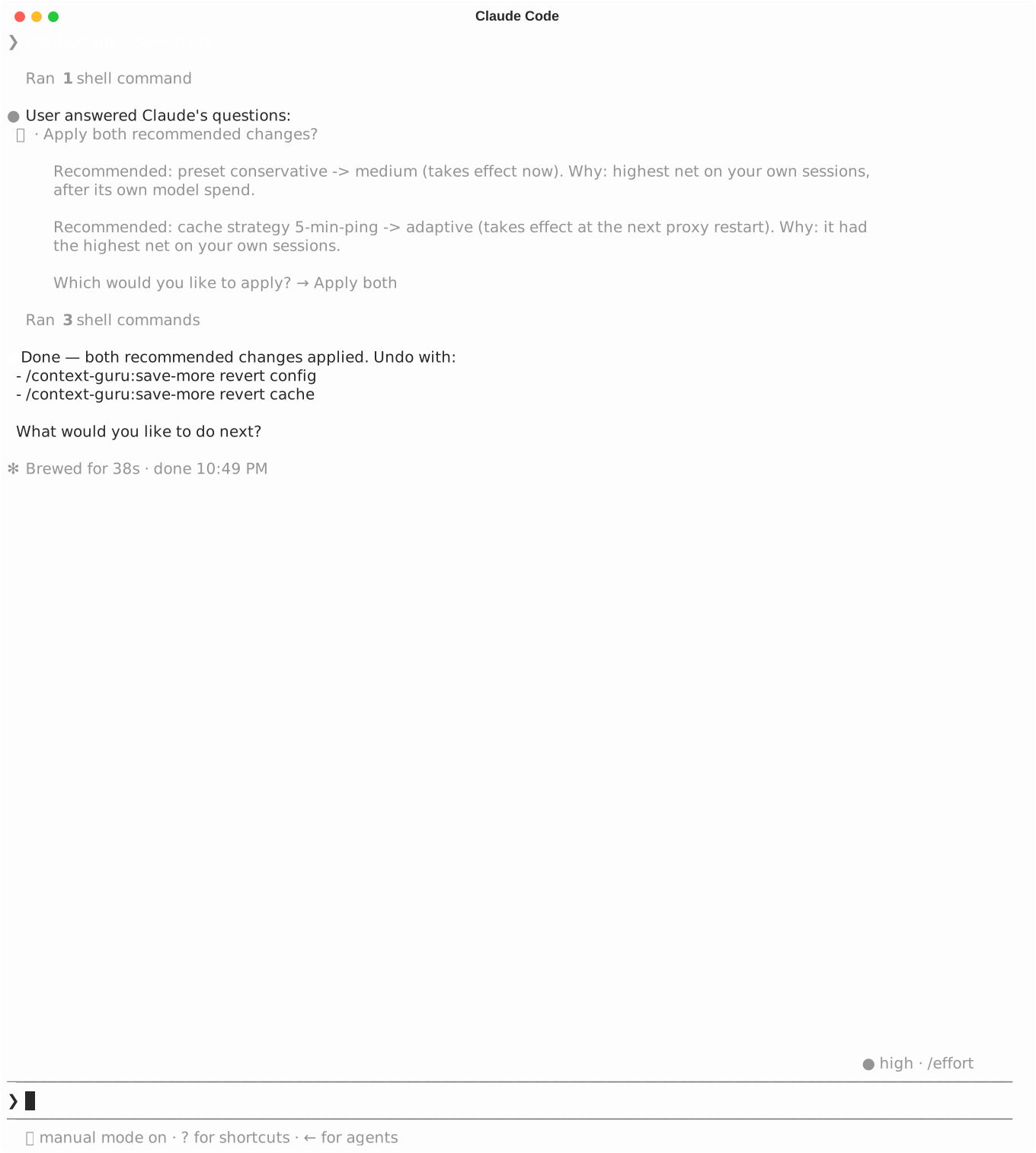
In Claude Code (real session, synthetic data): the one question, then Claude Code's own permission prompt for the change, then the result.
revert puts back the setting from before your last change made here:
If the numbers changed since you saw them, nothing is written and the current report is shown again. When the proxy's own check fails (a keep-alive plan that did not beat the default on your most recent sessions, for example) nothing goes live; switching it on regardless is a second, separate question, sent only with --force:
Not applied: The go-live check did not pass, so it runs in shadow and changes nothing.
Apply anyway, although that check failed: /context-guru:save-more apply cache by-segment@3f9a1c --force
The words may come in either order (apply cache X or apply X cache). A change typed under a read command (save-more revert config, config revert) is not run; the command prints the exact one to run instead.
Settings that cost you money
The default save-more also checks your own Claude Code settings for ones that make you pay for something you could get free. It shows a card only for the checks that fire. save-more settings shows just that card.
╭─ Settings that cost you money ──────────────────────────────────────────────────────────────────╮
│ CLAUDE_CODE_DISABLE_EXPERIMENTAL_BETAS=1 turns off the free server-side check in auto mode, so  │
│ Claude Code sends its own classifier requests and you pay for them.                             │
│   Set in: your user settings, ~/.claude/settings.json                                           │
│   Cost: about $249.52 over the last 30 days (6,016 requests)                                    │
│         also, classifier stage 2 (probably): $3.50, 12 requests, not added to the figure above  │
│   Fix: remove it. Do not add CLAUDE_CODE_AUTO_MODE_SERVER: the default already asks the server. │
│   Takes effect at the next Claude Code session.                                                 │
│   Risk: A gateway that rejects beta fields may return 400 errors. Claude Code 2.1.304 and later │
│   retries some of them itself. If errors start, undo this and run /context-guru:doctor.         │
│   Also changes: Tool search halves the tools field (58.5 KB to 28.6 KB), and context_management │
│   turns on.                                                                                     │
│                                                                                                 │
│ Session recap (awaySummaryEnabled) makes a model call for a one-line summary each time you come │
│ back after a few minutes away.                                                                  │
│   Set in: not set anywhere (on by default)                                                      │
│   Saves: one small model call each time you come back after a few minutes away.                 │
│   Fix: set "awaySummaryEnabled": false. Takes effect at the next Claude Code session.           │
│   Risk: You no longer see the recap line when you come back.                                    │
╰─────────────────────────────────────────────────────────────────────────────────────────────────╯
Apply it? Say yes, or run: /context-guru:save-more apply settings disable-experimental-betas
Apply it? Say yes, or run: /context-guru:save-more apply settings session-recap
Each check shows the setting, where it is set, what it cost in hindsight, the fix and the risk.
| Check | Fires when | Fix | Cost comes from |
|---|---|---|---|
disable-experimental-betas |
CLAUDE_CODE_DISABLE_EXPERIMENTAL_BETAS is 1 or true in the environment or in a settings env block |
remove the key from the file it is in | proxy rows with the classifier shape (Sonnet, no tools, 3 system blocks, max_tokens 64, not streamed, 2 messages). A second shape (max_tokens 2112) shows apart as "probably classifier stage 2" and is not added |
small-model-rejects-server-check |
ANTHROPIC_SMALL_FAST_MODEL or ANTHROPIC_DEFAULT_HAIKU_MODEL, at its effective value, names a Haiku older than 5.5 (for example claude-haiku-4-5, claude-3-5-haiku-...). Other models and ids it cannot read never fire. A key that is not set is not judged. It fires with the betas setting on or off. The card says it matters once that setting is off |
set each key that holds the old Haiku to claude-haiku-5-5, in the file that sets it |
proxy rows with the classifier shape, only in sessions that also have a Haiku request with status 400. These rows are also counted under disable-experimental-betas while it is on. The plugin does not ask the gateway whether it serves claude-haiku-5-5: the risk line tells you to check |
session-recap |
awaySummaryEnabled is unset or true, and CLAUDE_CODE_ENABLE_AWAY_SUMMARY is not 0 or false |
set "awaySummaryEnabled": false in ~/.claude/settings.json |
not priced: the fix stops one small side call each time you come back, so the card says what it saves ("Saves: ..."), not a dollar figure |
How it works:
- The plugin reads your settings on your machine. It reads
~/.claude/settings.json,~/.claude/settings.local.json, the project's.claude/settings.jsonand.claude/settings.local.json, managed settings, and the process environment. It reads only the keys a check names. It prints no other value and reads no secret. - The proxy prices them.
GET /api/adapt/settings?since=&until=returns, per check, the request count and summedcost_usdof your rows with that check's request shape. It uses columns only (model, tool count, system blocks,max_tokens, stream, message count, upstream status). One check also asks whether the same session has a row of another shape. That test uses the same columns, tenant and time window. It reads no request text. A check with no known shape returnsnull. - An old proxy still works. If the route answers 404, the settings still show, with "not measured yet".
- The list of checks is one file,
context-guru-plugin/scripts/costly_settings.json. A Go test keeps the proxy's price shapes equal to it.
Apply and undo use the same two commands as the other changes, and only after a yes:
/context-guru:save-more apply settings disable-experimental-betas
/context-guru:save-more revert settings disable-experimental-betas
- Apply backs up first. It writes
settings.json.<timestamp>.baknext to the file, edits only that one key, keeps the file mode (0600 stays 0600) and writes atomically. - Revert restores the exact previous value from a record the apply wrote. It refuses, and writes nothing, if that key in the file is not what the apply wrote.
- Some values cannot be changed here. A value from managed settings or from your shell environment shows "Cannot change" or an administrator note, and has no
Apply it?line. - Changes take effect at the next Claude Code session.
- A read never writes. The skill pre-approves reads only.
When it cannot run
| What you see | What to do |
|---|---|
No Context Guru proxy is routing this session |
/context-guru:install, or point at a proxy with CG_URL=http://127.0.0.1:PORT |
The proxy at ... is not answering |
open a new session (it starts the proxy) or run /context-guru:update |
This proxy is older than this command |
/context-guru:update |
The analysis took longer than 5 minutes |
a shorter window: --days 7 |
This proxy needs a sign-in for this |
on the hosted service, set CG_TOKEN to your context-guru token (taken from the agent's own cg_live_ key when there is one), or change it in the dashboard |
| any other sentence | the proxy's own reason (for example, too many reports at once); act on it |
The report format
On the hosted service the command authenticates with the account's own proxy token in x-context-guru-token; these routes accept it for the caller's own account only. A local proxy answers loopback callers without one.
Each report is one endpoint on the proxy's dashboard API, and each change is a POST to a second one. Integrations can use them directly. config is served at compaction, cache at cache, and /context-guru:remove-mcp-and-skills at tools.
GET  /api/adapt/{compaction|cache|tools}?since=<ms>&until=<ms>[&custom=1]
POST /api/adapt/{kind}/apply?since=<ms>&until=<ms>     {"option": "<id>", "basis": "<basis_id>"}
The report:
{
  "kind": "cache", "version": 1,
  "summary": "one sentence: the answer",
  "window": {"since": 0, "until": 0, "sessions": 0, "requests": 0},
  "class": "observed | counterfactual",
  "method": "how the options were evaluated, in a few words",
  "basis_id": "short id of this computation",
  "to_date": {"saved_usd": 0, "since": 0, "until": 0, "class": "observed", "items": 0},
  "current": "<option id>", "default": "<option id>", "best": "<option id>",
  "options": [{"id": "", "label": "", "detail": "",
               "class": "counterfactual | estimate",
               "billed_usd": 0, "saved_usd": 0, "spend_usd": 0, "net_usd": 0,
               "sessions_helped": 0, "sessions_hurt": 0}],
  "recommendation": {"option": "<id>", "change": "one line", "net_delta_usd": 0, "per_week_usd": 0,
                     "ci95": [0, 0], "items_n": 0, "effective": "now | restart | next_session", "reason": ""},
  "heatmap": {"label": "", "tz": "UTC", "values": [[0, "... 24 hours"], "... 7 days, Monday first"]},
  "removed": [{"kind": "", "name": "", "since_ms": 0, "saved_usd": 0}],
  "items": [{"kind": "", "name": "", "usd": 0, "last_used_ms": null, "remove": null}],
  "warnings": []
}
- Money is in US dollars at the prices the proxy is configured with. Every option is evaluated on the same window and the same sessions.
saved_usdis gross (versus no lever at all),spend_usdis what the option itself spends,net_usd = saved_usd - spend_usd.recommendationisnullwhen the current setting is already the best, or when there is too little data to say;summarythen says which.- Optional extras the screen shows when present:
relative(paired differences such asbest_vs_default, each{usd, ci95}, printed right under the summary),disagreement(one line, shown under the summary), per-optionheld_out(vs_default_usd,vs_default_ci95,builder_gate.pass; shown underdetails),unavailable(an option that could not be evaluated:net_usdisnull, never 0), andcalibration. to_dateis what the current setting saved so far (for tools: what earlier removals saved), the first line of the card; missing means not measured, never 0.per_week_usdgives the card's second line, with its spread:ci95is a 95% confidence interval and is shown as one;range_per_week_usd,gain_range_usdand per-optionrange_usdare bounds and are shown as a range, never as a confidence interval.payback_weeksabove 1 is said in the tools question.heatmap(cache) andremoved(tools) are drawn when present.custom=1(config) adds searched combinations to the shipped presets.itemsis used bytoolsonly, and never lists a built-in tool; the screen drops any item whose kind is notmcp_server,mcp_toolorskill.sessions_helped,sessions_hurt,detail,per_month_usdandreasonare optional.
The apply answer is {"ok": true, "applied": "<id>", "previous": "<id>", "effective": "...", "note": "one line", "undo": {"option": "<id>", "basis": "<basis_id>"}}. A body of {"option": "revert"} (no basis) undoes the last change made through this route; its answer has the same shape. "force": true is sent only after the user said yes a second time, when an earlier answer had "ok": false with "force_available": true. Errors are a non-2xx status with {"error": "a sentence"}: 400 for an unknown option, 409 when basis no longer matches the current report, 401 or 403 when the caller is not allowed to change the setting, 429 when too many reports or changes run at once. basis is required (400 without it). The command always sends one: for an option typed without one it reads the current report first and sends that report's basis_id. undo may carry its own basis (the report after the write), which the Undo: line includes. 501 means the proxy has no configuration it can write; its error says what to do instead.