Benchmark: context-guru vs headroom vs rtk vs baseline
SWE-bench Verified · 50 tasks · claude-code agent on aws/claude-sonnet-5, run live.
All 50 tasks scored (no infrastructure exception) under all four arms, so every
number below is apples-to-apples on the same tasks. Reproduce: REPRODUCE.md.
Per-config detail: baseline · context-guru ·
headroom · rtk. Component internals & real examples:
components.md.
Three of the four arms are compaction layers of two different kinds:
- context-guru and headroom are request-stream proxies — they compact the whole
messagesarray (system prompt + history + tool outputs) after it's assembled, on the network path to the model. - rtk (Rust Token Killer) is a shell-level hook — it rewrites the agent's Bash
commands (
cat→rtk read,pytest→rtk pytest, …) and compresses their output at the source, before it ever enters the transcript. It is not on the network path.
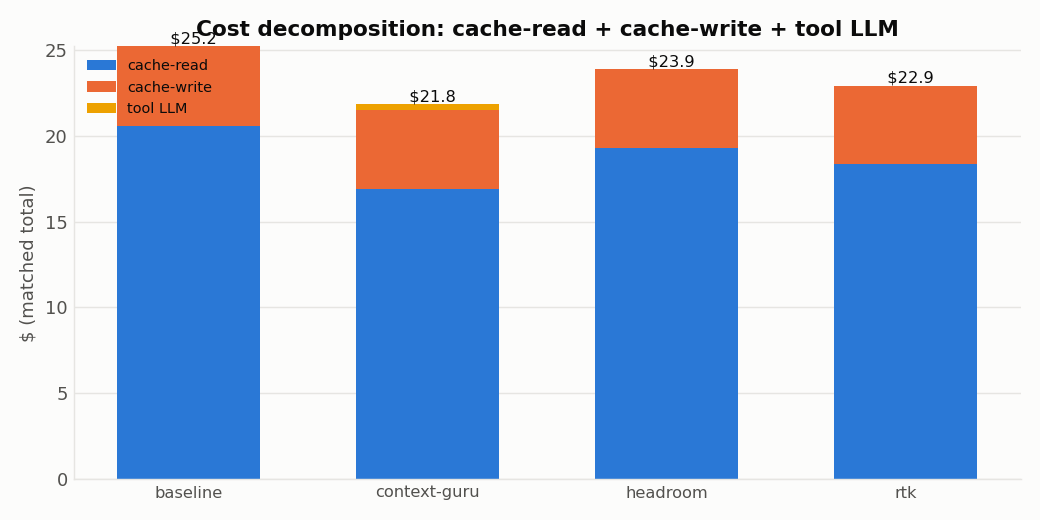
Cache-aware billed input cost = fresh $2/M · cache-read $0.20/M · cache-write $2.50/M, recomputed from each trial's own token tiers; output billed at $10/M. Total adds the tool's own compaction-LLM cost.
These figures record what ran, and the comparison against headroom and rtk is
apples-to-apples. The shipped codesmart pipeline has changed since, so a claim about
today's default needs a re-measurement — see Benchmarks.
Headline
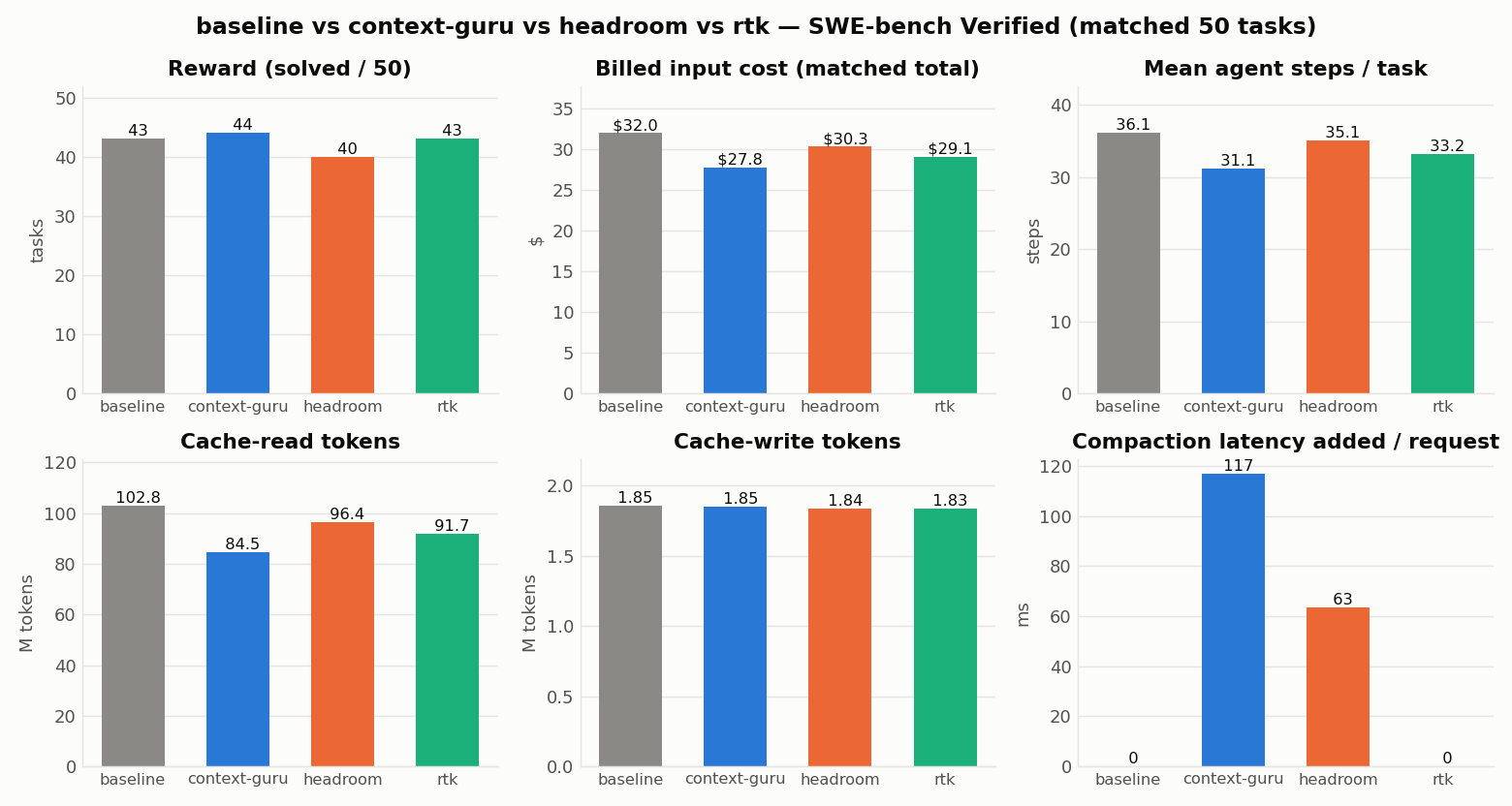
context-guru is the cheapest and highest-reward arm — but the striking result is that rtk, a simple deterministic shell filter, is the 2nd-cheapest arm and beats the sophisticated headroom proxy on both cost and reward, at zero request-path latency and zero tool cost.
| dimension | baseline off |
context-guru | headroom | rtk | winner |
|---|---|---|---|---|---|
| reward (solved / 50) | 43 (86%) | 44 (88%) | 40 (80%) | 43 (86%) | context-guru |
| total billed cost | $31.98 | $27.77 (−13.2%) | $30.30 (−5.3%) | $29.09 (−9.0%) | context-guru |
| cache-read tokens | 102.8M | 84.5M (−17.8%) | 96.4M (−6.3%) | 91.7M (−10.8%) | context-guru |
| cache-write tokens | 1.855M | 1.847M | 1.839M | 1.835M | ≈ tie (all within 1.1%) |
| cache-read $ | $20.57 | $16.90 | $19.28 | $18.33 | context-guru |
| cache-hit rate | 98.14% | 97.73% | 98.01% | 97.94% | ≈ tie |
| mean steps / task | 36.1 | 31.1 | 35.1 | 33.2 | context-guru |
| mean agent wall / task | 380 s | 352 s | 364 s | 384 s | context-guru |
| compaction added latency / req | — | 117 ms | 63 ms | 0 ms | rtk |
| tool's own LLM cost | $0 | $0.31 | $0 | $0 | rtk / headroom |
| content removed (per req) | 0 | 1.09% | 2.64% | 65.8% of bash only | — (different denominators) |
| exceptions (of 50) | 0 | 0 | 0 | 0 | tie |
The content removed row is not comparable across the two kinds: context-guru/headroom
measure removal against the whole request; rtk's 65.8% is of bash output only (its
bytes/4 estimate), a small slice of a ~98%-cached agent's context — which is exactly why
its 65.8% bash reduction nets to −9% on the bill, not −66%.
Verdict
- context-guru wins the dollar-and-reward metrics — lowest billed cost ($27.77, −13.2% vs baseline), lowest cache-read, fewest steps, and the most tasks solved (44).
- rtk is the surprise — the 2nd-cheapest arm (−9.0%), it matches the baseline reward (43, reward-neutral), uses fewer steps (33.2), and does it with zero request-path latency and $0 tool cost because it runs in the shell, not on the model path. It beats headroom on both cost and reward despite being far simpler.
- headroom lands third on cost (−5.3%) and lowest on reward (40). Its one remaining edge over context-guru is deterministic hot-path latency (63 vs 117 ms/req) — but rtk matches baseline latency (0 ms added to the request) and undercuts headroom on cost, so headroom is squeezed from both sides here.
- Cache-write is a four-way wash (1.855M / 1.847M / 1.839M / 1.835M — within 1.1%): none of the arms busts the cache. rtk is inherently cache-safe — it shrinks output before it is ever cached, so there is no cached prefix to invalidate (the problem the proxies must engineer around with freeze-and-replay).
- All four arms ran all 50 tasks with zero infrastructure exceptions.
Why the ranking comes out this way
- context-guru removes the least per request (1.09%) yet is cheapest because it
freezes each compaction and replays it byte-identically every turn, so the reduction
compounds across the whole session's cache-reads (−17.8%), and it compacts the entire
request — including large file reads via the built-in
Readtool that never touches a shell. - rtk only sees output the agent routed through the Bash tool (
cat,grep, test runners); Claude Code's built-inRead/Grep/Globbypass its hook. That is its structural ceiling — and yet, because bashcat/grep/test output is a real chunk of a coding session, a deterministic 66% cut of it still compounds (it enters the cache pre-shrunk on every turn) to −10.8% cache-read and −9% cost. - headroom removes the most raw content per request (2.64%) but does not target the biggest file reads as deeply as context-guru's LLM skeletonizer, and it lost 3 more tasks.
Cost decomposition
Where every dollar goes (matched total): cache-read is the dominant term on a ~98%-cached agent. context-guru shrinks it the most (at a $0.31 haiku bill); rtk shrinks it deterministically for free; headroom shrinks it least of the three compaction arms.
Per-task
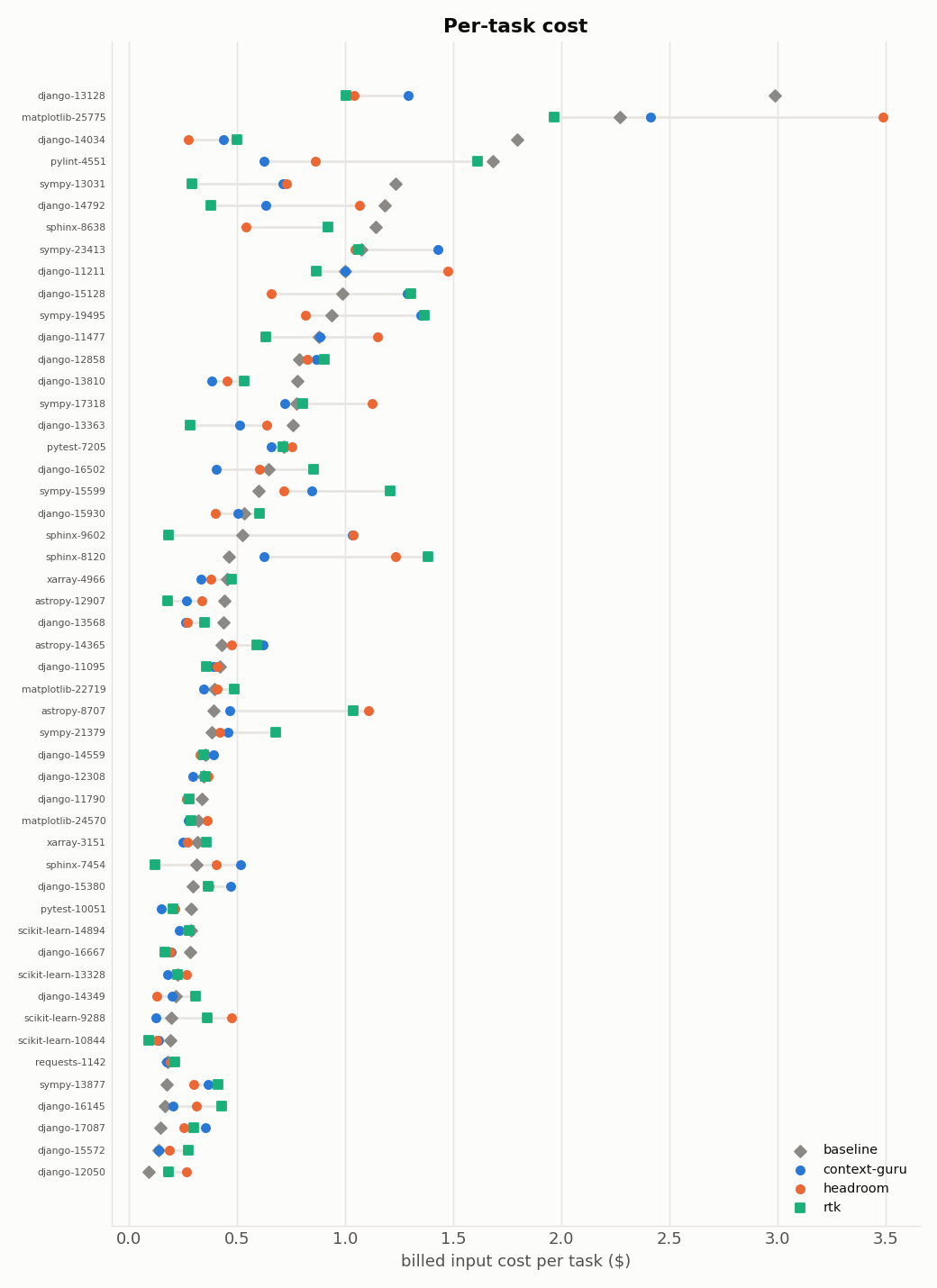
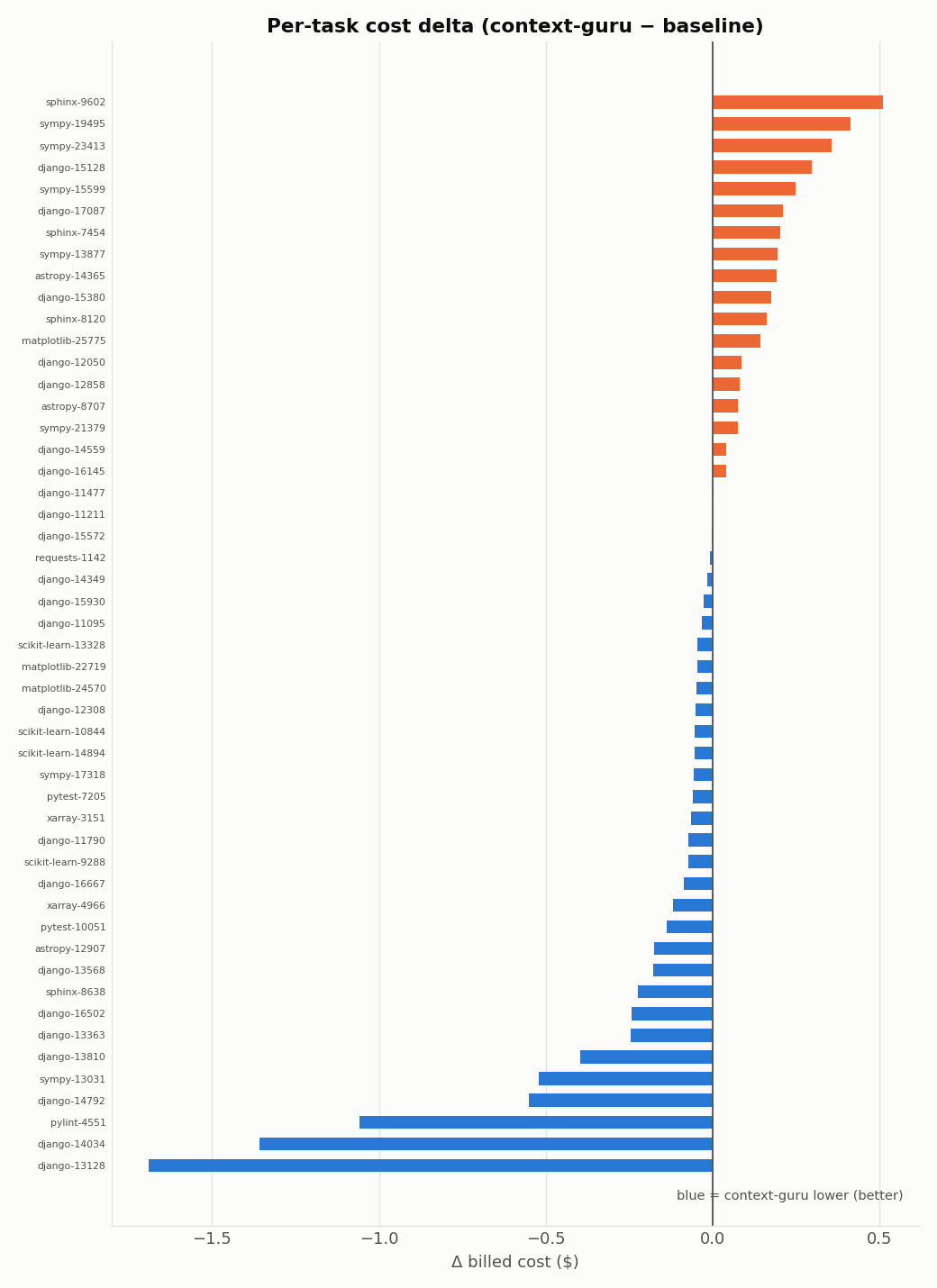
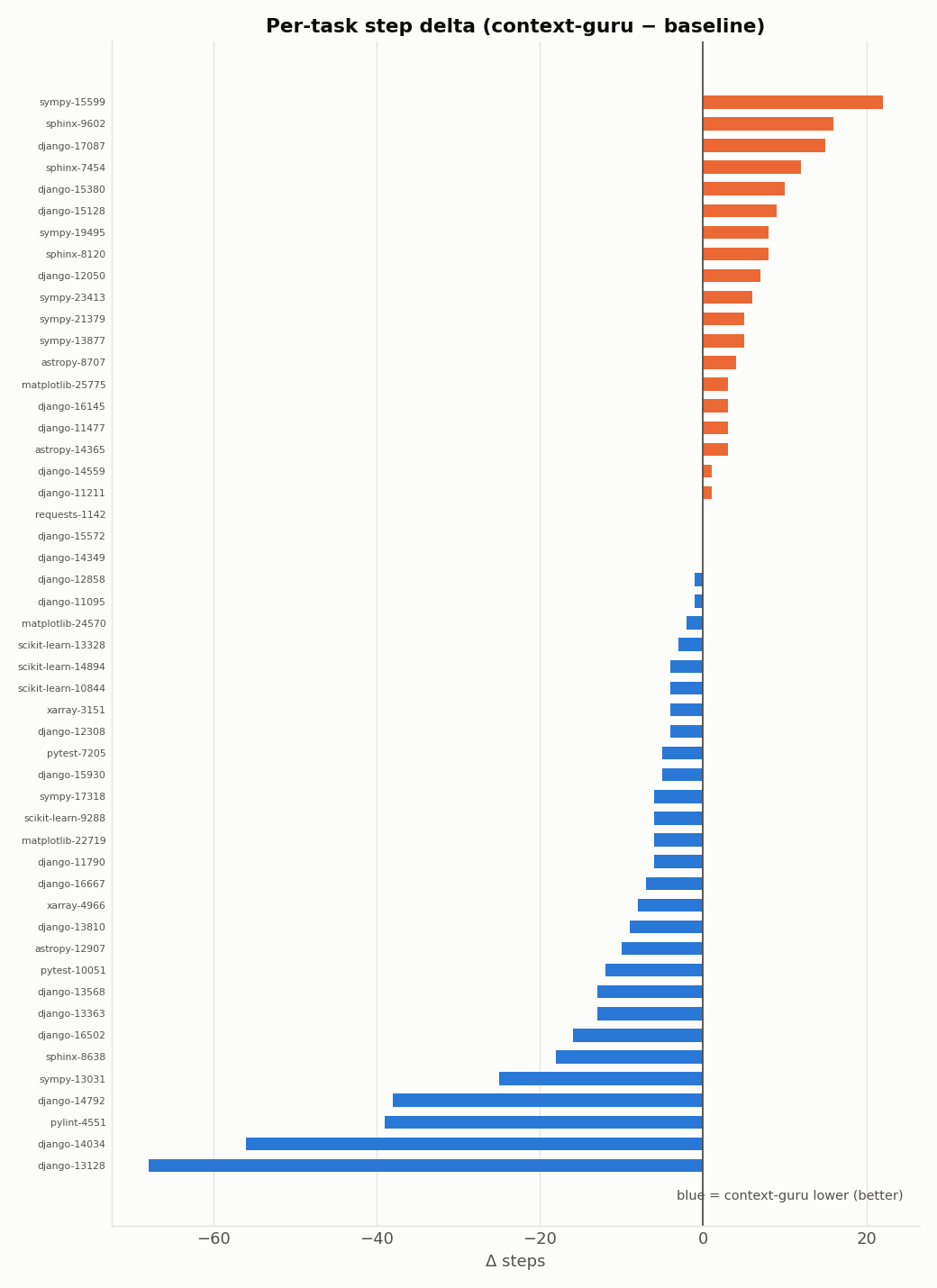
Per-task billed cost (baseline ◆ · headroom ● · context-guru ● · rtk ■) and the per-task deltas vs baseline — context-guru is at/below baseline on nearly every task:
Per-component / per-compressor
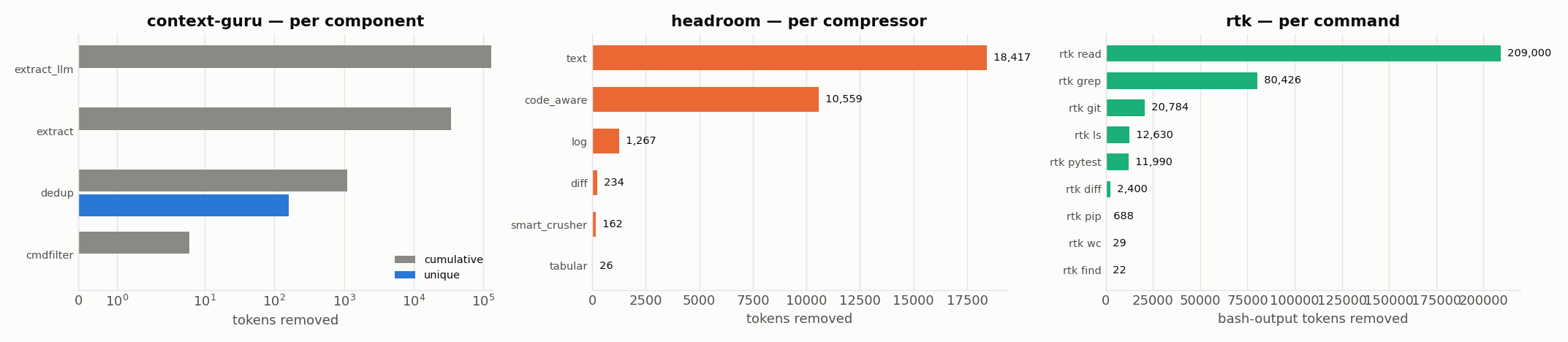
context-guru's savings come from extract_llm (LLM skeletonization of large file
reads/logs) + the deterministic extract (ANSI/CR + noise) + cmdfilter/dedup;
headroom's from its deterministic text and code_aware (AST) compressors; rtk's from
cat→read file skeletonization (62%) and grep grouping/truncation (24%), then git /
ls / pytest. Cumulative vs unique tokens (context-guru re-applies the same compaction every
turn, so cumulative ≫ unique):
Full component internals, trigger conditions, and real before→after examples for all three tools are in components.md.